

As a functional medicine practitioner and dietitian, the GI Map and Genova GI Effects test changed my practice. When I discovered that I could order stool tests and gain new insights into my clients healing journey, I was beyond excited. After 6 years of working with these tests, it is time to move on, and here is why.
Great Technology, Wrong Application
GI Map uses PCR technology which is an incredible way to get a high accuracy read on whether or not a specific bacteria or bacterial toxin is in the ecosystem. This is important when you are doing diagnostic work and want to understand why someone has diarrhea for 4 days straight or has blood in their stool or is very sick with pain in their gut. You want to be able to say YES, for example, Shiga-like Toxin E. coli stx1 was found and you need treatment stat! You have a very sick patient who needs answers immediately. However, in my line of work, having patients with chronic digestive issues or issues that have been persistent for months, we are not dealing with life-threatening toxins. I don’t need to be looking for highly toxic bacterial pathogens because I am not the right person to treat it, nor will I have the answers for them in a timely manner. Most microbiome tests take 2-3 weeks to get your results and that is too long to wait when you are having an acute digestive problem.
PCR Testing Doesn’t Show a Microbial Ecosystem
PCR testing was designed to identify specific bacteria, fungus and viruses and this was one of the reasons I loved this test and used it for as long as I did. It gave me a really wonderful high-level picture of the microbiome. However, as our understanding of the microbiome evolves, we are finding that it is more important to accurately see the species and strains of bacteria and what amounts of the ecosystem they occupy. Bacteria can change their function based on who is surrounding them, who is in their ecosystem. This is a process called quorum sensing and its basically a way bacteria communicate to share information about survival and adaptation. If one bacteria learns a function and it supports the larger ecosystem, it will share that function with other bacteria so they can start to adopt that function. A 2019 study also found that bacteria will share metabolites (food) and this can help create a more stable, resistant to invasion, and resilient ecosystem. So it really is all about the ecosystem, not just looking at a handful of bacteria and listing them as bad or good.
PCR technology was designed to find only what it is told to find. If you look at a GI Map test you have 9 “normal bacterial flora” that are being analyzed. That is it, just 9. The problem with this approach is we have an exorbitant amount of bacteria in our gut and each person has wide levels of variations in the types of bacteria they have. When you only look for 9, you miss the larger picture. And this test does not quantify how much of the ecosystem the bacteria are occupying, it basically just says it is high or low and if you do a follow-up test you can really only ask yourself is it less high or less low, which as a clinician is helpful, but it's not giving the complete picture.
Since I am working with people with chronic issues, I need to accurately see their bacterial ecosystem. I need to know true relative abundance or the percentage of bacteria that occupy the lower intestinal tract. With an ecosystem based analysis I can see more than if something is high or low, I can see how much real estate it occupies. This is important because high akkermansia is beneficial if it's 19% of the ecosystem, but if it's higher than that it can actually start to have a negative impact on the body.
Here we can see results from a GI Map test where Akkermansia is elevated, but if you asked me what amount 2.46e5 is, I would not be able to tell you. It's just high.

When we look at a test that measure the relative abundance of the bacterial ecosystem, the picture looks like this:
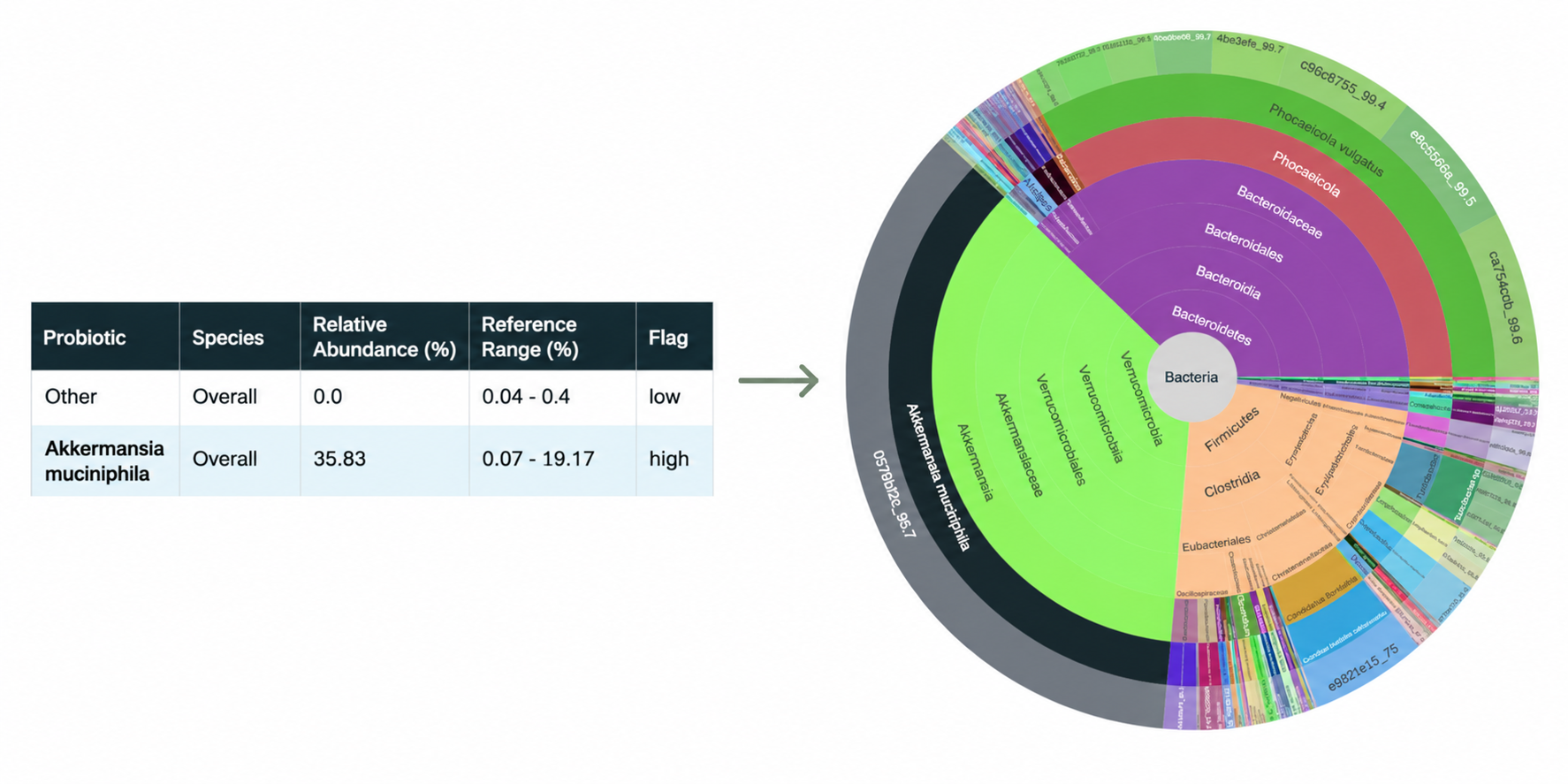
And now I can say this is 35% of the ecosystem which is 16x higher than the reference range. And it's something that I can confidently track and re-test to see the impact of my interventions. It is much easier to see a percentage decrease than a decrease in 2.46e5. And not just being able to measure the decrease, but the technology looking for the percentage of bacteria is more accurate than the q/PCR method of quantification so I find the ecosystem approach a better tool for what I do in my practice.
And here is where a PCR test really falls short. When I use a longread sequencing technology I can see all bacteria, even if they are not in the database because they are being identified based on genetic patterns. If there is something that is not known, it will still be reported on because it takes up a percentage of the ecosystem.
In this example, I ran a GI Map test along with a GutID test and found that Bacteroides uniformis took up about 64% of the ecosystem. On my GI Map test, since it doesn't look for this specific bacteria, it was not reported and it skewed the relative abundance. On the GI Map test it actually showed low levels of Bacteroides but that is only because it wasn’t looking specifically for Bacteroides Uniformis so by missing that species, it skewed the phyla level representation.
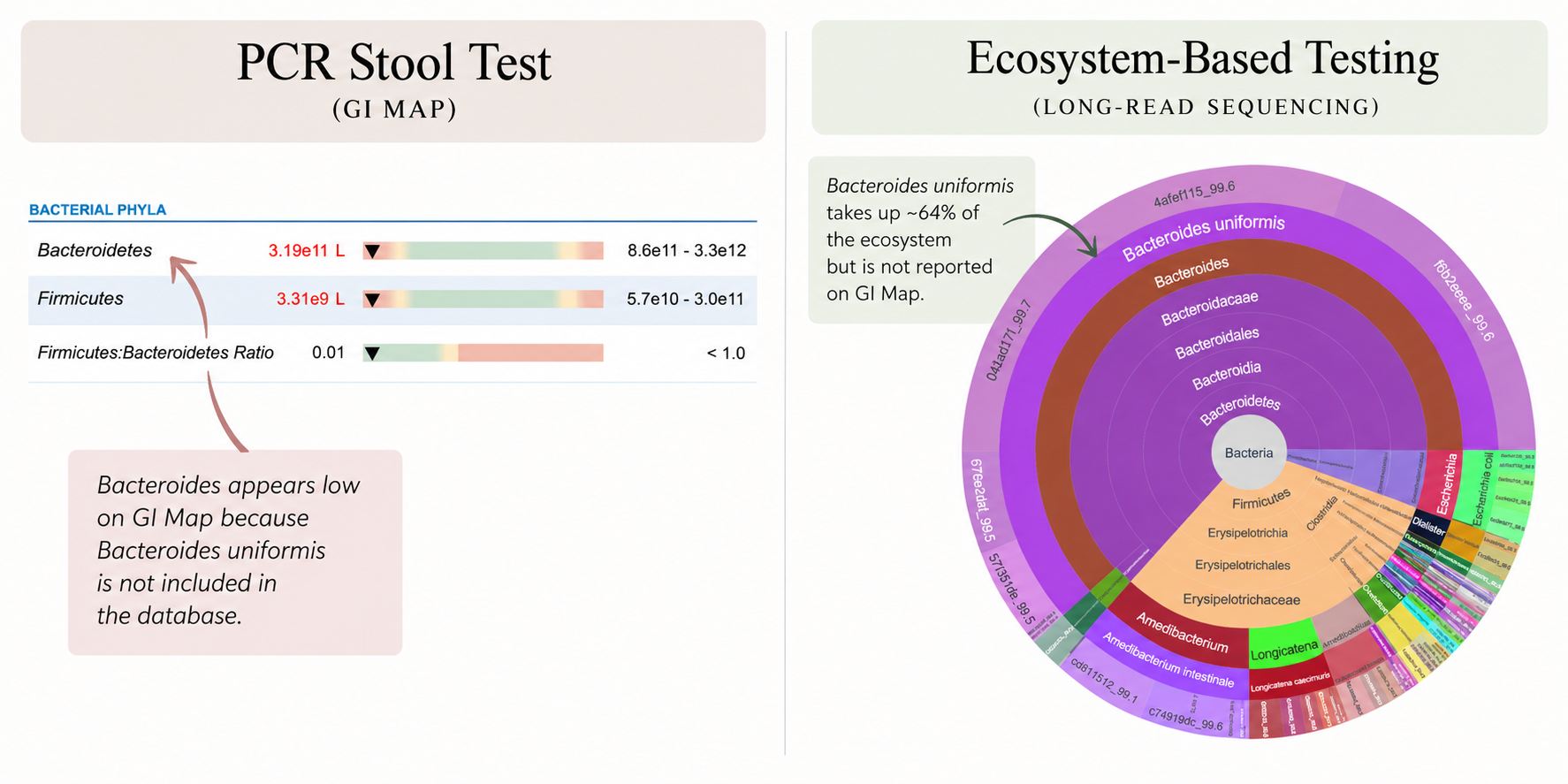
The ecosystem is everything. It is not only about looking at individual bacteria to determine if something is bad or good. We still have bacteria that can disrupt the ecosystem, but the more important thing to look at is how the ecosystem functions as a community.
Impact and Clinical Insights
I am sharing this to highlight how important the right information is when it comes to supporting digestive imbalances. Whether you are a practitioner or a human on your own healing journey, it's important to know your specific microbial ecosystem. Technology and research is advancing and the way we approach microbiome health (especially with the advent of Next Generation Sequencing) as clinicians needs to be changing.
By understanding the microbial ecosystem and my clients symptoms, I can make more practical interventions and my clients are getting better, more sustainable results. Instead of just decreasing symptoms, we are also increasing resilience. That means better immune function, higher ability to resist pathogens, more flexibility with foods and just overall feeling better. And you know what the best part is? I am able to read complex microbiome information and provide very simple interventions that have a measurable impact. If you have been on a journey with your gut and you experience the yo-yo pattern of my gut gets better, then it gets worse again, it's time for a new approach.
Check out the Gut Story Lab where we test your microbiome and get to know your ecosystem.